


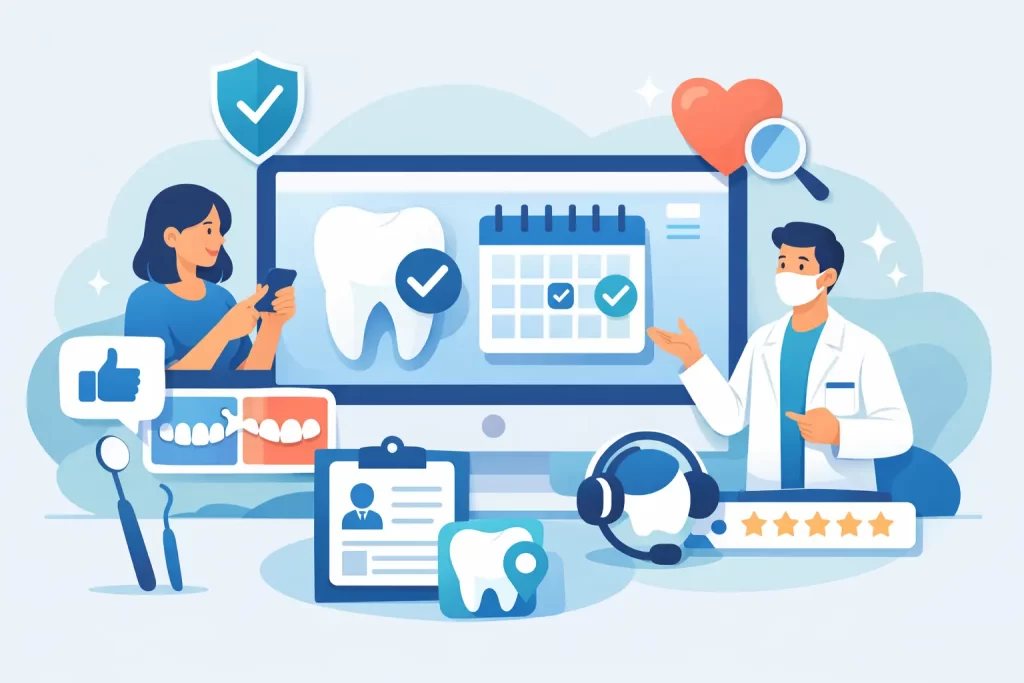
A patient searching for an emergency dentist at 9:30 p.m. is not evaluating your practice based on clever design alone. They want to know whether you can help, where you are, whether you take their insurance, and how quickly they can contact you. If those answers are difficult to find, the appointment often goes to the practice one town over.
The best dental website features are built around that decision moment. They make your practice easier to find, easier to trust, and easier to contact. More importantly, they support the business outcomes that matter: more qualified calls, more online bookings, stronger case acceptance, and a marketing investment you can measure.
Best Dental Website Features Start With Clear Patient Paths
A dental website should not force every visitor through the same generic experience. Someone seeking a routine cleaning has different concerns than a patient researching dental implants or trying to resolve a broken tooth. Your website must guide each visitor toward the most relevant next step.
Start with a homepage that immediately states who you serve, where you are located, and what makes your practice a practical choice. A clear headline, a visible phone number, and a prominent appointment button do more for conversion than a large image carousel or vague claims about “exceptional care.”
Your navigation should also be organized around real patient needs. Core services such as general dentistry, cosmetic dentistry, implants, Invisalign or clear aligners, emergency dentistry, and pediatric dentistry should be easy to reach. Do not bury profitable services beneath broad labels that make patients hunt for answers.
Each service page needs to do more than define a treatment. It should explain who the treatment is for, what problem it solves, what the process typically involves, and how to schedule a consultation. For high-value treatments, include realistic expectations about timelines, comfort, financing, and candidacy. Patients often delay care because they are uncertain, not because they are uninterested.
1. Mobile Speed That Does Not Cost You Appointments
Most local dental searches begin on a phone. A slow, cluttered mobile website can waste paid ad clicks and weaken your visibility in local search results. It also sends the wrong signal to a prospective patient who is deciding whether your office feels organized and current.
Fast loading pages, compressed images, clean code, and reliable hosting are basic requirements. So is regular maintenance. A website that performed well two years ago may now be weighed down by outdated plugins, oversized videos, or technical errors that no one noticed.
Mobile usability matters just as much as speed. Buttons must be easy to tap, forms should be short, and the click-to-call option should work instantly. Patients should not need to zoom in, scroll through a long menu, or copy a phone number before they can take action.
2. Online Booking With a Real Backup Option
Online appointment requests can increase conversions, especially after office hours. But booking tools must match the way your front desk operates. A complicated scheduler that displays inaccurate availability creates frustration and extra administrative work.
For many practices, the right approach is a simple booking request form connected to a fast staff follow-up process. For others, real-time scheduling makes sense. It depends on your appointment types, provider schedules, insurance verification process, and whether you need to protect time for new-patient exams or emergency care.
Whatever system you use, give patients more than one way to act. A strong dental website places a phone number, appointment button, contact form, and office location in obvious places. This is not redundancy for its own sake. Different patients have different preferences, and every unnecessary barrier can reduce response volume.
3. Trust Signals That Answer the Questions Patients Ask
Dentistry is personal, and patients are careful about who they choose. Your website needs credible proof that reduces anxiety before someone calls your office.
Professional staff photography is one of the most valuable additions a practice can make. Authentic photos of your dentists, team, reception area, operatories, and exterior create a more believable first impression than generic stock images. They help patients recognize your office when they arrive and make the practice feel more familiar.
Patient reviews, testimonials, credentials, professional memberships, years in practice, and accepted insurance information also matter. The goal is not to overload every page with badges. The goal is to place relevant proof where a patient needs reassurance. An implant page may benefit from before-and-after cases and treatment experience, while an emergency dentistry page should emphasize availability, compassion, and speed of response.
Before-and-after galleries deserve extra care. Use only properly authorized patient images, present them honestly, and avoid implying that every patient will receive the same result. Clear expectations protect your reputation as much as they support conversion.
4. Local SEO Foundations Built Into the Website
A beautiful website that does not appear when local patients search has limited commercial value. Your site should support local SEO from the ground up, not treat it as an add-on after launch.
That means every location page should show consistent practice details, including your name, address, phone number, hours, map information, and service area. If your practice has multiple offices, each location needs its own useful page rather than a thin duplicate with a different city name.
Service pages should use the language patients actually search for. “Tooth replacement options” may sound polished, but people also search for “dental implants near me,” “same-day crown,” “emergency dentist,” and “Invisalign dentist.” The right wording depends on your market and the services you genuinely provide.
Technical SEO also plays a role. Search engines need clear page structure, descriptive titles, accurate schema markup, indexable content, and no major performance issues. These details are not glamorous, but they help turn your website into an asset that can generate local visibility month after month.
5. Clear Financing and Insurance Information
Cost uncertainty stops many patients from booking. You do not need to publish a fixed price for every procedure, especially when treatment plans vary. You do need to make it clear that your practice has a practical conversation ready.
Explain which insurance plans you accept, whether you offer financing, and how patients can request an estimate or benefits check. For major treatment pages, a short explanation of payment options can reduce hesitation and give patients a reason to contact you instead of assuming care is out of reach.
Be direct without making promises you cannot keep. Insurance coverage varies, and treatment recommendations should follow an examination. Straightforward language builds more trust than promotional pricing that creates confusion later.
6. Emergency Dentistry Information That Works After Hours
Emergency searches are high-intent searches. A patient with severe pain, swelling, a cracked tooth, or a knocked-out tooth is looking for immediate direction, not a long brand story.
Your emergency page should clearly state your hours, how to reach the office, what to do if the office is closed, and the types of urgent issues you handle. Put the phone number at the top of the page and make it clickable on mobile devices.
This page should also be medically responsible. Offer basic, safe guidance while encouraging patients to contact your office or seek urgent medical care when appropriate. Avoid presenting general website content as a substitute for professional evaluation.
7. Conversion Tracking You Can Use to Make Decisions
Without tracking, it is difficult to know whether your website is producing appointments or simply receiving traffic. A dental practice should be able to see which channels generate calls, form submissions, booking requests, and consultations for high-value services.
Track the actions that represent genuine opportunity: click-to-call activity, appointment forms, scheduler completions, direction requests, and consultation requests. Then connect that data to your Google Ads, SEO, social media, and local marketing efforts. A page that gets fewer visits but produces more implant consultations may be far more valuable than a high-traffic blog post.
Privacy needs to be considered from the beginning. Forms should request only the information needed to start a conversation, and your systems must be configured to handle patient information appropriately. Ask your marketing and technology providers exactly how tracking, form data, and website access are managed.
8. Ongoing Support Instead of a One-Time Launch
A dental website is not finished when it goes live. Staff changes, new services, seasonal promotions, shifting hours, Google updates, and new reviews all create reasons to update the site. Neglected websites gradually become less accurate, less secure, and less effective.
Your provider should be able to make important changes without forcing you through a long queue or charging a surprise fee for every small update. Regular backups, security monitoring, performance checks, and clear reporting give practice owners confidence that their lead-generation asset is being protected.
TASProMarketing approaches dental websites as part of a wider customer acquisition system, connecting web design with local visibility, advertising, content, reporting, and ongoing technical support. That matters because a website should not sit apart from the rest of your marketing. It should give every campaign a credible place to convert interest into action.
The right website feature is not the one that looks most impressive in a design presentation. It is the one that helps a worried patient choose your practice, gives your staff a better lead to follow up with, and makes the next marketing dollar work harder. Start by reviewing your own site on a phone, as if you needed care today. The gaps are usually easier to spot than you think.


